A running feed of what I'm reading and listening to — articles, podcasts, audiobooks, and posts.
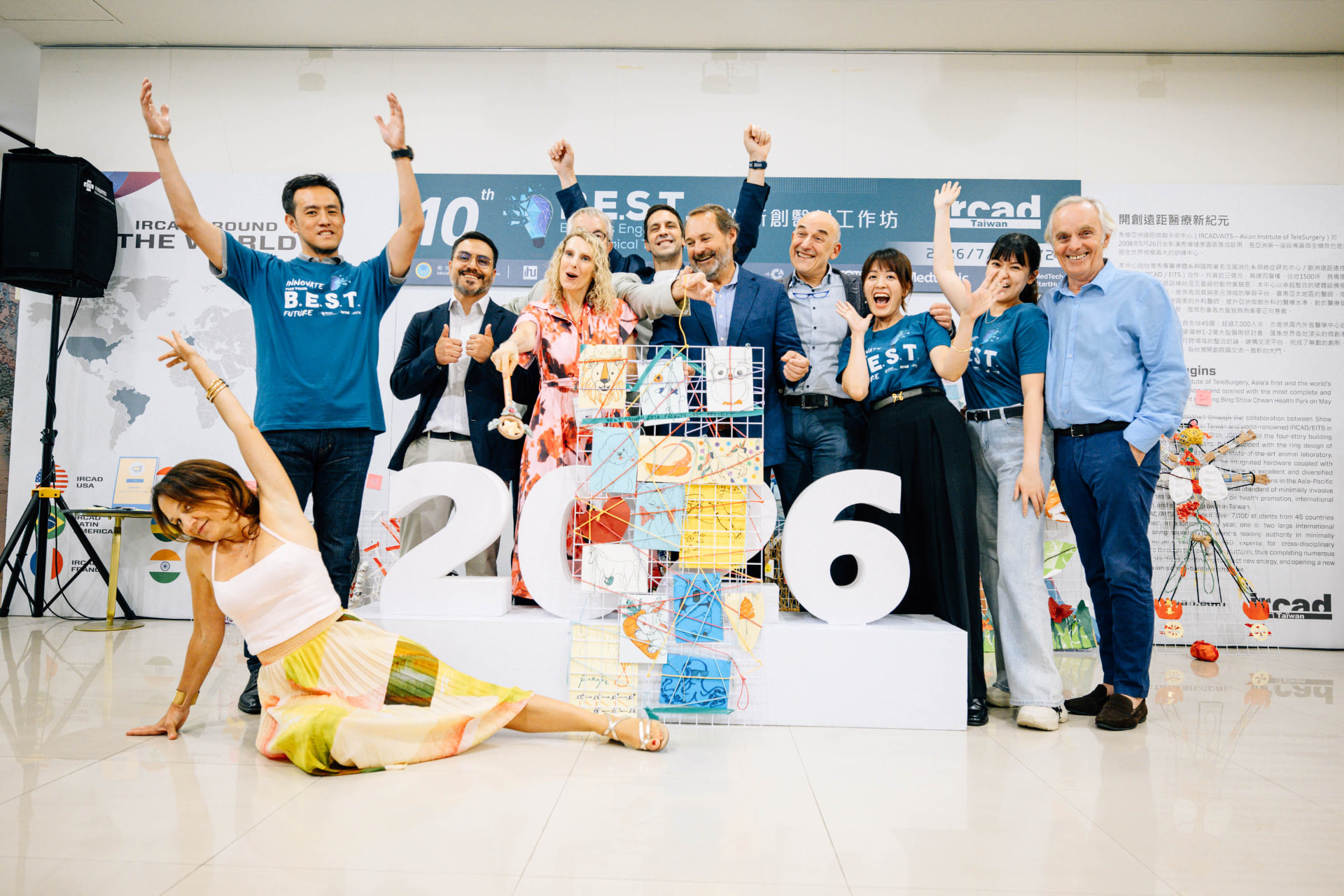
The B.E.S.T. faculty at IRCAD Taiwan — 10th edition, July 2026.
Teaching innovation twice in one summer — B.E.S.T. in Taipei and Strasbourg
My postJuan VerdeBy Juan Verde
Sep 2026
Two editions of the same course, five weeks apart, on opposite sides of the world.
B.E.S.T. is the innovation and technology-transfer course developed by IHU Strasbourg. I first went through it as a participant in 2018; since 2019 I've been on the faculty and coaching teams. This summer it ran twice, and I taught seven lectures between them.
IRCAD Taiwan — 20–24 July
Mind the Gap — how to find a real clinical need rather than a comfortable one
Filtering Your Concepts — deciding which idea survives contact with reality
A Primer in Intellectual Property
IP Case Studies
Regulatory & Reimbursement Primer
IHU Strasbourg — 24–28 August
Practical Guide to Finding YOUR Need
Design Thinking: Sticky Notes Won't Save You
That last title is deliberately provocative, and I meant it. Design thinking gave medtech a shared vocabulary and a lot of very energetic workshops. But a wall of sticky notes is not a strategy. Ideation is the cheap part — teams rarely fail for lack of ideas. They fail because the need was never sharply defined, because nobody checked who already owns the space, or because the regulatory and reimbursement path was treated as someone else's problem, later.
So both blocks close the same way: with the unglamorous work. A need statement you can defend in front of a skeptic. Evidence that the problem is worth solving. An honest look at the IP landscape before you build. A regulatory path sketched at the beginning, not the end.
The other reason I keep teaching this: the questions are excellent. Clinicians and engineers in the room ask things that don't respect the boundaries of your own project — and you go back to the lab thinking differently.
A survey of the fast-growing field of interventional needle robots — Quantum Surgical, XACT, Perfint, NDR, Mendaera and a dozen more — and what to call them.
New cancer-care software for image-guided liver ablation — biomechanical deformable registration and AI segmentation to assess and improve ablative margins, plus the RayImaging platform.
On the ergonomic toll of sonography and HERA, a robot-assisted ultrasound solution (Life Science Robotics) that lets the sonographer steer the probe by joystick.
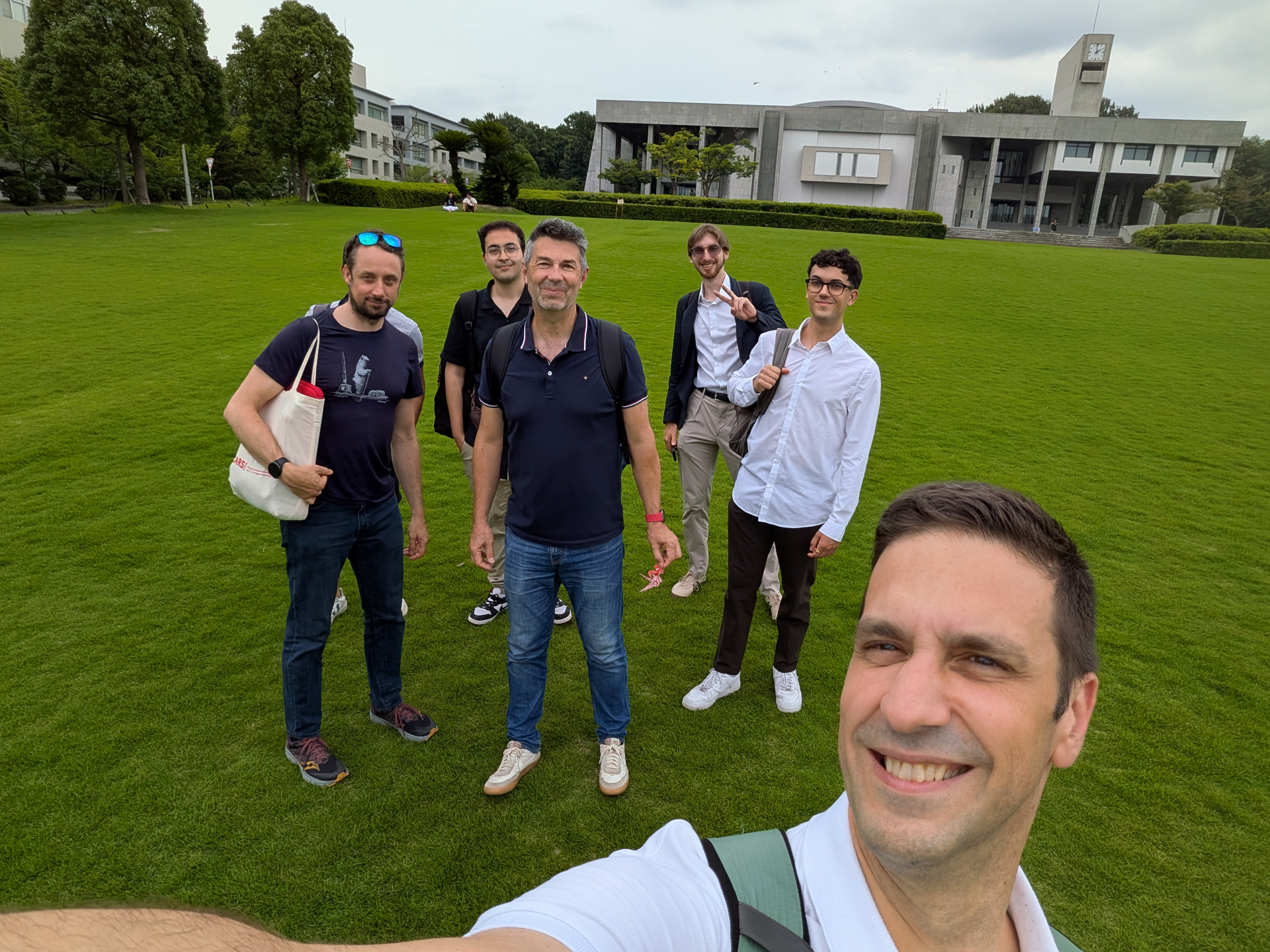
Our team on the Nagoya University campus — IPCAI 2026.
IPCAI 2026, Nagoya — team recap & a Best Presentation award
My postJuan VerdeBy Juan Verde
Jul 2026
Just back from IPCAI 2026 in Nagoya — and still smiling.
IPCAI — the International Conference on Information Processing in Computer-Assisted Interventions — is one of the most selective venues where surgery, imaging and AI meet. This year it was hosted at the Toyoda Auditorium of Nagoya University, Japan (2–4 July), co-located with CARS.
I was fortunate to be part of three papers our team presented:
Personalization of Liver Microwave Ablation Simulation — Best Presentation (Audience Choice) Award 🏆. Presented by Francesco Dettori. Authors: Francesco Dettori, Ilias Nahmed, Michel Duprez, Juan Verde, Pablo Alvarez, Stéphane Cotin.
A Digital Twin for Microwave Liver Treatment Re-planning. Presented by Ilias Nahmed. Authors: Ilias Nahmed, Francesco Dettori, Juan Verde, Michel Duprez, Pablo Alvarez, Stéphane Cotin.
DefSynUS — real-time, patient-specific intrahepatic vessel identification. Presented by Karl-Philippe Beaudet. Authors: Karl-Philippe Beaudet, Yordanka Velikova, Sidaty El Hadramy, Nassir Navab, Philippe Cattin, Juan Verde, Stéphane Cotin.
I hold a research affiliation with Inria's MIMESIS team, and this work is part of our shared mission there — patient-specific, image-guided liver interventions.
Beyond our own work, what struck me was where the field is heading. A few threads I followed closely:
→
Surgical AI agents & LLMs moving into navigation and decision support
→
Digital twins and the "OR of the future" — from photorealistic operating-room twins to simulating rare events
→
Ultrasound and needle guidance getting smarter and more real-time
→
3D reconstruction, registration & navigation, including AI-driven endovascular guidance
→
Segmentation & domain adaptation, increasingly powered by synthetic data
But honestly, the best part was the people — long corridor conversations, poster debates, and reconnecting with the modeling/simulation and image-guided-surgery groups we work with, plus meeting teams from across Europe, the US and Asia tackling the same hard problems. That community is what keeps this field moving.
Grateful to the co-authors, our partners and the organizers — and to Nagoya for the hospitality (and the lawns).
Onward: making interventions more precise, more personalized, and more image-guided.
A market overview of ultrasound's momentum — AI-enabled imaging, handheld point-of-care devices, and expanding oncology, cardiology and vascular applications.
The phase-3 RCT shows thermal ablation reduced morbidity, mortality and hospital stay, with non-inferior overall survival versus surgery for small-size CRLM.
SpineUs builds a full 3D surface reconstruction of the spine as the probe moves, with optical tracking and no radiation — a foundation for radiation-free navigation.